
A written lockout/tagout (LOTO) procedure protects no one if the people applying it do not know it. That is why the rules in all four markets covered here require training, not just a written procedure. What exactly they ask for, however, differs from country to country.
This article summarises what the rules in the United States, the United Kingdom, the European Union and Australia require from LOTO training, what the training usually covers and where practice in virtual reality fits. It is a guide, not legal advice: always check the current text of the regulations and any national or state rules that apply to your site.
United States: OSHA 29 CFR 1910.147
The OSHA general industry standard on the control of hazardous energy links training to each person’s role (construction, agriculture and maritime work are among its exclusions). It distinguishes three groups:
- Authorized employees – the people who lock or tag out machines in order to service or maintain them. They must be trained to recognise the hazardous energy sources, the type and magnitude of energy available in the workplace, and the methods and means needed to isolate and control it.
- Affected employees – people who operate or use a machine being serviced, or who work in the area where servicing takes place. They must be instructed in the purpose and use of the energy control procedure.
- All other employees whose work is or may be in an area where energy control procedures are used. They must be instructed about the procedure and about the prohibition on attempting to restart or re-energise machines that are locked or tagged out.
Authorized and affected employees must be retrained when their job assignment changes, when a change in machines, equipment or processes presents a new hazard, or when the energy control procedure changes. Retraining is also required when a periodic inspection reveals, or the employer has reason to believe, that there are deviations from, or inadequacies in, employees’ knowledge or use of the procedure. Its aim is to re-establish proficiency and to introduce new or revised methods where needed.
The employer must also certify that training has been carried out and is being kept up to date. The certification must contain each employee’s name and the dates of training. OSHA’s Lockout/Tagout eTool explains these requirements in more detail.
United Kingdom and the European Union
The main UK regulations on work equipment and training implemented the same EU directives, so the core requirements are very similar. Neither has a single lockout/tagout regulation; the duties come from general rules:
- Isolation from energy sources. Work equipment must have clearly identifiable means of isolating it from all its energy sources, and reconnecting an energy source must not put workers at risk (Directive 2009/104/EC, Annex I, point 2.14; in the UK, regulation 19 of PUWER 1998, which applies where appropriate and also requires the means to be readily accessible).
- Maintenance with the equipment shut down. It must be possible to carry out maintenance this way or, where it is not, with appropriate protective measures (Directive 2009/104/EC, Annex I, point 2.13; in the UK, PUWER regulation 22, so far as is reasonably practicable).
- Designated, trained people for maintenance. Where equipment involves specific risks, repairs, modifications, maintenance and servicing must be restricted to workers specifically designated for that work, who must receive adequate training for it (Directive 2009/104/EC, Articles 6 and 9; in the UK, PUWER regulation 7).
- Training at the right moments. Training must be given on recruitment, on transfer or change of job, when new work equipment is introduced or equipment is changed, and when new technology is introduced. It must be adapted to new or changed risks, repeated periodically where necessary and given during working hours, at no cost to workers (Framework Directive 89/391/EEC, Article 12). The UK equivalent is regulation 13 of the Management of Health and Safety at Work Regulations 1999: training on recruitment and on exposure to new or increased risks, including a new or changed system of work. Section 9 of the Health and Safety at Work etc. Act 1974 bars charging employees for it.
Machine builders have their own duty: under the Machinery Directive 2006/42/EC, machinery must have isolators that can be locked if reconnection could endanger people, and any energy remaining or stored in its circuits must be able to be released without risk. From 20 January 2027 the EU, together with Northern Ireland, replaces the directive with the Machinery Regulation (EU) 2023/1230; Great Britain keeps the Supply of Machinery (Safety) Regulations 2008.
EU member states transpose the directives into national law and often add detail – for example the Working Conditions Decree (Arbobesluit) in the Netherlands, or the Ordinance on Industrial Safety and Health (BetrSichV) and its technical rules in Germany. In the UK, HSE’s guidance HSG253 The safe isolation of plant and equipment covers process isolation in the oil, gas and chemical industries.
Australia: WHS laws and codes of practice
Australia has no single LOTO regulation either. Under the Work Health and Safety (WHS) laws, a person conducting a business or undertaking (PCBU) must, so far as is reasonably practicable, provide any information, training, instruction or supervision necessary to protect all persons from risks arising from the work, and the WHS Regulations require operator controls on plant to be able to be locked in the “off” position so that all motive power can be disconnected.
Practical detail is set out in the Code of Practice Managing the risks of plant in the workplace, which includes a section on the isolation of energy sources, and in regulator guidance. SafeWork NSW, for example, expects a system confirming that people have been trained and assessed as competent, in both theory and practice, before they are issued with personal lockout devices. Victoria applies its own Occupational Health and Safety Act 2004 and regulations instead of the model WHS laws.
What LOTO training usually covers
Whatever the country, LOTO training usually covers:
- the energy sources in your plant – electrical, mechanical, hydraulic, pneumatic, thermal, chemical and gravitational – including energy stored in springs, pressurised lines, raised parts or capacitors,
- the sequence of each procedure: preparing for shutdown, shutting down, isolating, applying locks and tags, releasing stored energy, verifying isolation, and later removing the devices and returning the equipment to service,
- how affected people are informed before the devices are applied and after they are removed,
- group lockout and shift or crew changes, where several people work on the same equipment,
- the roles on your site: who may apply locks, who is affected and who only needs to know the rules,
- an assessment of skills, not only knowledge, before anyone applies locks on their own – the Australian guidance above is a good model.
Classroom, hands-on and VR: what each method is good for
Most plants combine several methods, because each covers a different part of the training:
- Classroom or e-learning suits the rules, types of energy, roles and your company’s LOTO policy. It does not build practical skill on the equipment.
- Hands-on practice on real equipment covers the complete procedure on the machine itself. Its limit is that the equipment has to be taken out of service, and procedures used only during shutdowns are hard to schedule.
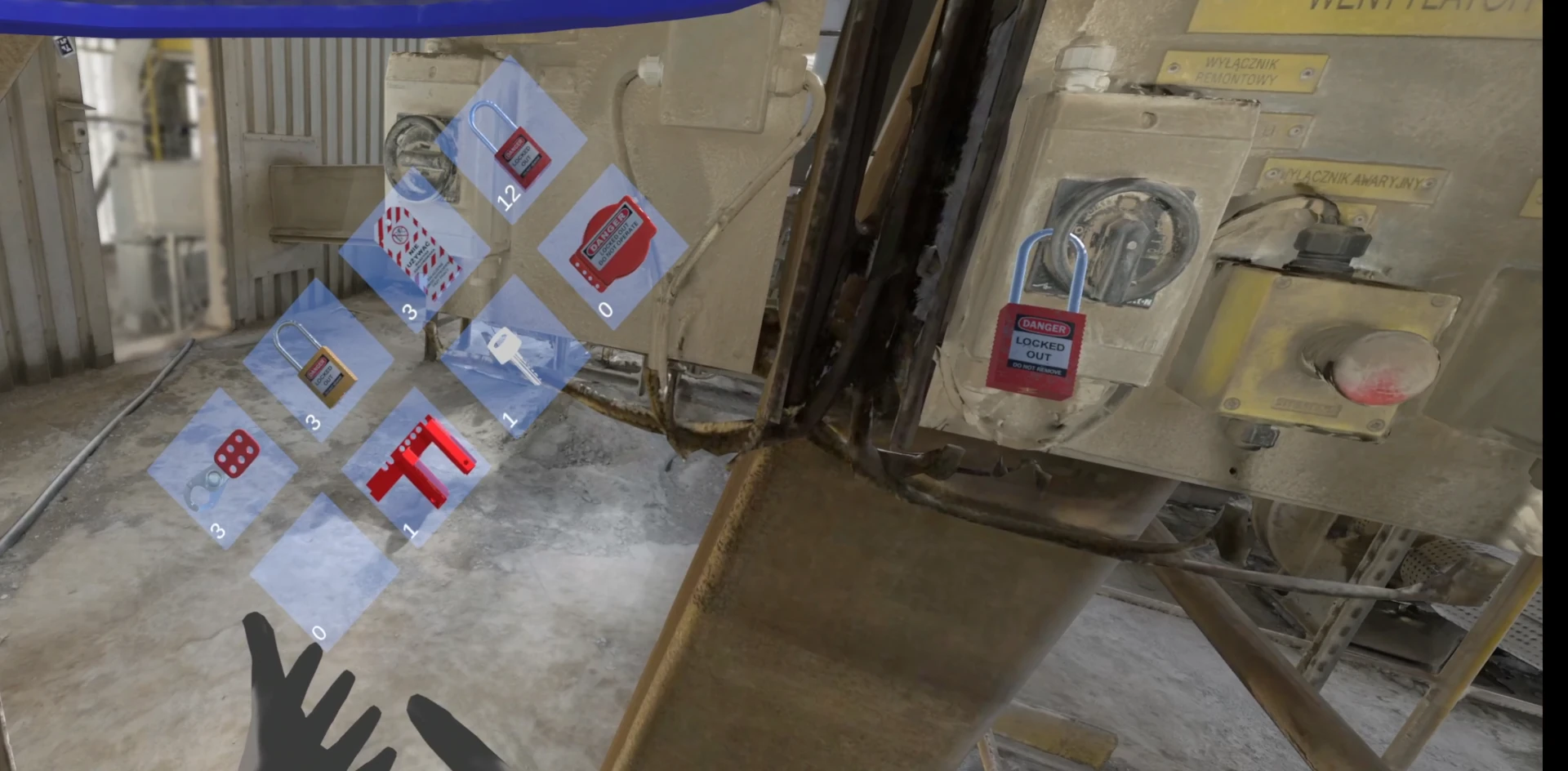
- VR practice in a digital twin of the plant lets people repeat your own isolation sequences, including the release of stored energy, as often as they need and before they go on site. It complements, but does not replace, hands-on training and the authorisations required by your procedures.
XR LOTO, our VR lockout/tagout training, recreates the area of your plant in 1:1 scale; its test mode gives the trainee and the trainer a score and a list of mistakes. How a session works step by step is explained in LOTO VR Training: How Lockout/Tagout Practice in VR Works.
Training is only half of it: checking LOTO on the shop floor
Training and assessment show that people know the procedure. They do not show whether a particular lock is applied right now, whose padlock is on which isolation point or whether a key has left the lockbox too early. LockControl detects whether padlocks are actually applied and keys are in place, and reports deviations as they happen. It does not replace the check that the equipment is de-energised before work starts. Its event history also shows where daily practice drifts from the procedure – which is where refresher training brings the most value. More in Digital LOTO: How to Monitor Lockouts in Real Time.
Frequently asked questions
Is lockout/tagout training required every year?
None of the rules described here sets a fixed retraining interval for everyone. In the US, the yearly requirement is a periodic inspection of each energy control procedure, carried out at least annually by an authorized employee other than the one using it; for lockout, it includes a review of each authorized employee’s responsibilities. Many plants also set a fixed refresher interval in their own safety rules.
Is tagout training different from lockout training?
In the US, yes. Where tags are used, OSHA requires employees to be trained in their limitations: a tag is a warning, not a physical restraint; it must not be removed without authorisation or bypassed; it must be legible, durable and securely attached; and it can create a false sense of security. Australia’s plant Code of Practice makes the same point: a tag provides information, but only a lock isolates an energy source.
Do contractors need LOTO training?
Yes – they need to know the rules of the site where they work. OSHA requires the host employer and the outside employer to inform each other of their lockout/tagout procedures, and the host employer must make sure its own employees understand and comply with the restrictions and prohibitions of the contractor’s energy control programme. Under the EU framework directive, the employer must ensure that workers from other companies on its premises have in fact received appropriate instructions on the risks. Typically, contractor staff complete the site’s LOTO induction and apply personal padlocks under its rules.
Does LOTO training have to use our own procedures?
General courses are a useful introduction, but the rules point to site-specific training. The EU framework directive requires training specific to each worker’s workstation or job, and the OSHA requirements described above refer to the energy in the employee’s own workplace. In practice, that means training on the machines, isolation points and procedures of your own plant.
See XR LOTO for your plant
We can show how your teams could practise your plant’s own lockout instructions in VR. Book a demo